

SUV vs sedan: which to rent in Dubai?
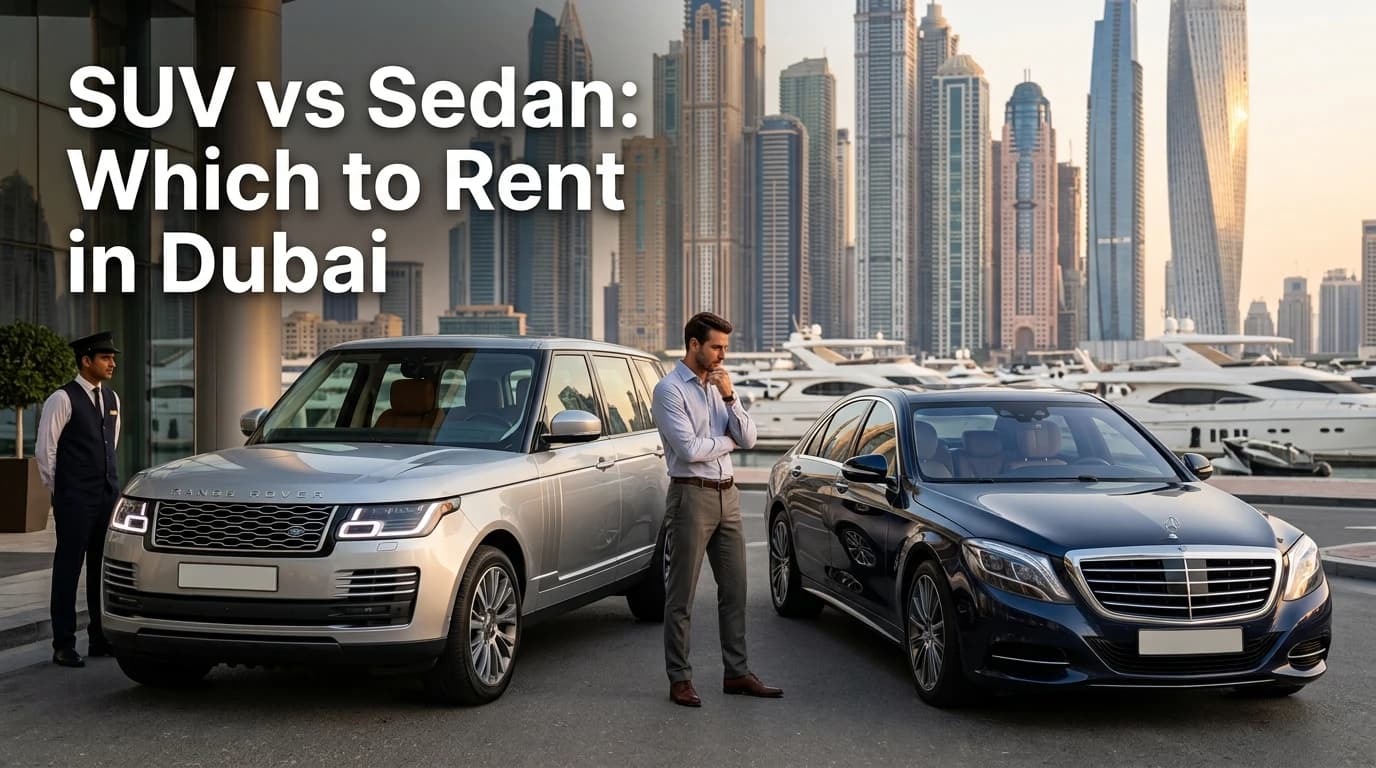
Most people booking a car for a Dubai trip get stuck on the same screen. A neat sedan at one price, a tall SUV at almost double, and no clear sense of which one actually fits the week ahead. The honest answer is that it depends on where you are driving and who is in the car, and the gap between the two body styles is wider than the photos suggest. This guide compares a Dubai sedan rental and an SUV rental on the things that really decide it: city driving, parking, the price you pay, fuel at the pump, family space, and whether you plan to leave the tarmac.
Where you will actually drive
Start with the route, because it settles most of this before you ever look at a price.
If your week is hotels, malls, the beach and a few restaurant runs along Sheikh Zayed Road, a sedan does everything you need. The roads are wide, smooth and fast, and a small car like a Nissan Sunny or a Toyota Yaris sits in that traffic perfectly well. You will not miss the height.
If your plan includes a run to Hatta, a day in the Hajar mountains, the road up to Jebel Jais in Ras Al Khaimah, or any kind of soft-sand detour, the calculation flips. The climb to Jebel Jais is long and steep, and a small engine fighting the gradient with the air conditioning on full is no fun. A mid-size SUV like a Mitsubishi Pajero or a Toyota Fortuner has the power and the cooling to take it in stride. For desert tracks the SUV is not a preference, it is a requirement, and we will come back to that.
The price difference is real
This is usually the deciding factor, so here are numbers you can plan around for 2026.
An economy sedan such as a Nissan Sunny rents from roughly AED 70 to 130 per day, dropping lower on a weekly or monthly booking. A proper mid-size SUV runs higher. A Mitsubishi Pajero sits around AED 140 to 220 per day depending on the supplier and season, and a Toyota Fortuner climbs to AED 200 and up, sometimes well past AED 300 at peak times or with a premium operator.
Over a seven-day trip that gap is the difference between roughly AED 600 and AED 1,500 or more, before fuel. For a city-only holiday that is a lot to spend on ground clearance you will never use.
One thing to check on the cheapest sedan rates is the excess. A headline price that looks unbeatable often carries a security deposit hold and an insurance excess of AED 1,500 or more, which is the amount you would pay if the car is damaged. Ask for the excess figure and the deposit before you book, not after.
Fuel is the cost people forget
The daily rate is only half the running cost. Fuel is the other half, and it widens the gap further.
In June 2026 Special 95 petrol is AED 3.83 per litre, fixed across the country for the month. A Nissan Sunny uses somewhere around 5 to 6 litres per 100 kilometres in normal mixed driving. A petrol Fortuner or Pajero in Dubai traffic realistically drinks 12 to 14 litres per 100 kilometres, sometimes more in stop-start conditions with the air conditioning working hard.
In plain money, the SUV burns roughly twice the fuel of the sedan for the same distance. Drive 500 kilometres in a week and the sedan costs you somewhere near AED 110 in petrol while the SUV costs closer to AED 250. Not ruinous, but real, and it stacks on top of the higher daily rate.
Family, luggage and the people in the car
Numbers aside, the body style has to fit the people.
A sedan handles two adults and a couple of small bags with room to spare. Add two kids, a week of suitcases and a pushchair and a small sedan starts to feel tight, with the boot full and the back seat crowded. That is the point where an SUV earns its rate. A seven-seat Pajero or Fortuner takes a family with luggage, folds the third row down for cargo when you do not need the seats, and gives you a higher seating position that many parents prefer for visibility.
Fitting child seats is also easier in the taller cabin, and the extra doors-to-ground height saves your back when you are buckling a toddler in twenty times a day. For a couple or a solo traveller, none of that matters and the sedan wins on cost.
Parking and city manoeuvring
Dubai parking is mostly generous, but the sedan still has the edge in the tight spots.
Multi-storey car parks at older malls, residential towers and some Downtown buildings have narrow bays and low clearance barriers. A small sedan slides into a space a large SUV has to fight for, and squeezes under height limits that occasionally catch out the taller cars. Reversing and lane-changing in dense Marina or Deira traffic is simply easier in a smaller car.
The SUV gives you commanding visibility and confidence on the open road, but in a packed parking structure that height and width become a mild liability. If most of your driving is urban, this leans sedan.
The desert question
This is the one place where the answer is absolute.
If you intend to drive on sand, in the dunes around Al Qudra, on the desert approaches near Lahbab, or on the rougher tracks toward the east coast and Oman, you need a four-wheel-drive SUV and you need the rental insurance to allow off-road use. Many standard rental agreements exclude off-road driving entirely, which voids your cover the moment you leave the tarmac. A sedan on sand is a recovery call waiting to happen, and a stuck car in the desert is an expensive afternoon.
For a Musandam trip across the Oman border you will also want the Oman insurance extension arranged in advance, and a capable SUV makes the mountain switchbacks far more comfortable. If desert or border driving is on your list, the SUV is the only sensible pick, full stop.
The verdict
For a city-based trip, holidays spent around Dubai, Abu Dhabi and the coast, with a couple or a small group, the sedan wins clearly. It is cheaper to rent, far cheaper to fuel, easier to park, and capable of everything the main roads ask of it.
Choose the SUV when at least one of three things is true: you are travelling as a family with full luggage, you are heading into the mountains toward Hatta or Jebel Jais, or you are going off the tarmac into the desert or across to Oman. In those cases the extra rate and fuel buy you space, climbing power and the ground clearance the trip genuinely needs.
If you are still on the fence, picture the single hardest drive of your week. If it is a mall car park, rent the sedan. If it is a sand track or a loaded family run up a mountain, rent the SUV. When you have decided, you can book either one from us at 24baba with the excess and deposit spelled out before you collect the keys.
FAQ — Common Questions Answered.
Is a sedan or an SUV cheaper to rent in Dubai?
A sedan is cheaper on both counts. An economy sedan rents from around AED 70 to 130 per day, while a mid-size SUV starts near AED 140 and climbs past AED 200 to AED 300 for popular models. The SUV also uses roughly double the fuel, so the running-cost gap is even larger than the daily rate suggests. For city driving the sedan is the clear value choice.
Can I drive a rental sedan in the desert in Dubai?
No, you should not take a normal sedan onto sand. It lacks the ground clearance and four-wheel drive to handle dunes or soft tracks, and most rental insurance excludes off-road driving, which voids your cover the moment you leave the road. For any desert plans you need a four-wheel-drive SUV with off-road use allowed in the agreement. Confirm this with the rental desk before you book.
Which is better for a family visiting Dubai?
An SUV suits a family with children and full luggage better. A seven-seat model like a Pajero or Fortuner carries suitcases, child seats and a pushchair without the squeeze a small sedan creates, and the higher seating helps with both visibility and loading kids. If you are a couple or travelling light, a sedan saves you money without any real downside.
Do I need an SUV for a trip to Hatta or Jebel Jais?
You do not strictly need one, but a mid-size SUV makes those mountain drives much easier. The climbs to Hatta and Jebel Jais are long and steep, and a small engine struggles with the gradient while running the air conditioning. An SUV has the power and cooling to handle it comfortably, especially with a full load of passengers and bags.