

Petrol vs electric rental in Dubai: which one should you actually book?
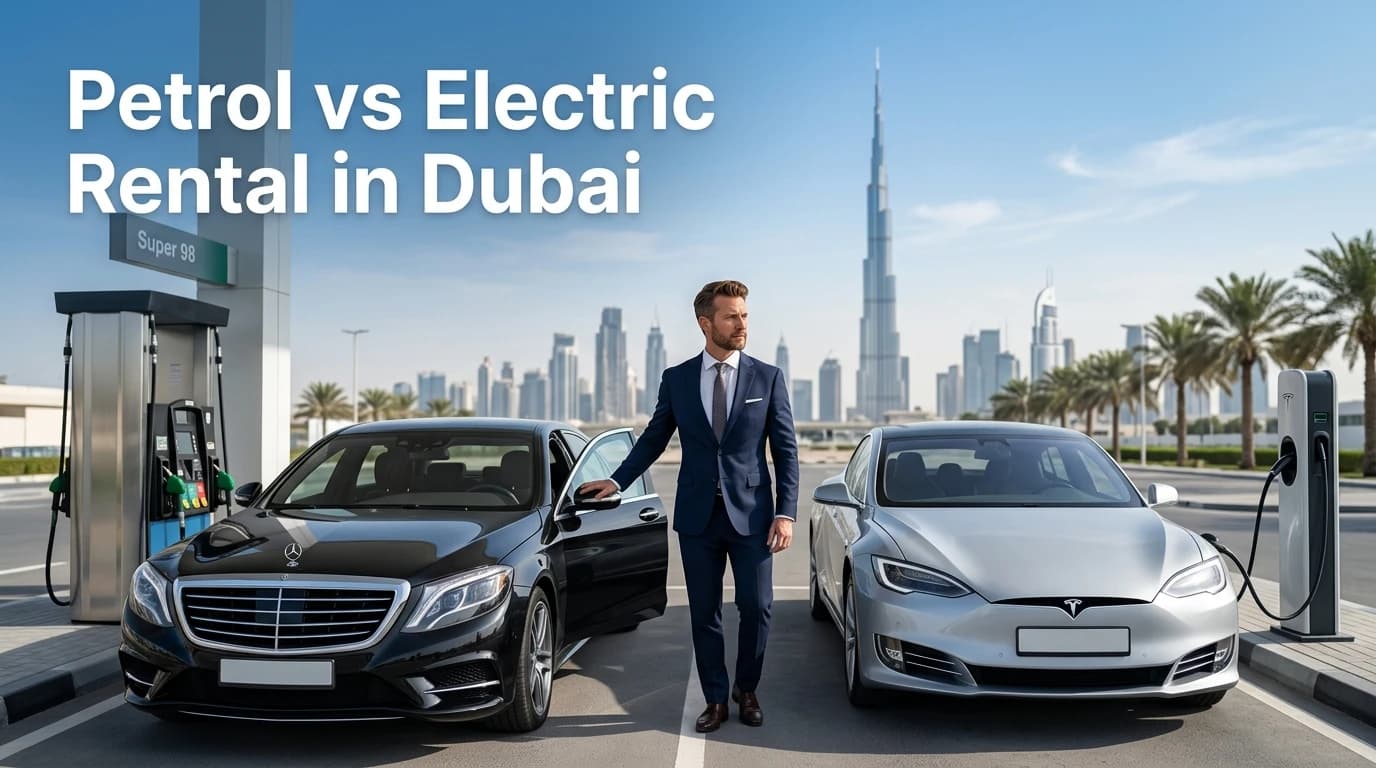
The honest answer is that it depends on where you are driving, not on which one is newer or cooler. An electric rental can be the cheaper, calmer choice for a week of city hopping in Dubai. A petrol car is the safer booking the moment your plan involves a long desert run, the Hatta climb, or the border into Oman. Both are easy to rent here. The mistake is picking one before you know your route. So here is how I steer people at the desk when they ask whether to go petrol or electric for their Dubai trip.
What you actually pay to keep each one moving
This is where electric wins on paper, and it is worth being precise about why. Petrol is reasonable here by global standards but it is not free. In June 2026, Special 95 sits at AED 3.83 per litre and Super 98 at AED 3.95. A mid-size petrol SUV that drinks 9 litres per 100 km will cost you somewhere around AED 35 in fuel for a 100 km day around town.
Charging an EV is cheaper per kilometre, but mind which number you are quoting. The headline AED 0.29 per kWh you see floating around is mostly the home or promotional rate. At a DEWA public charger, the registered-user tariff is AED 0.70 per kWh plus VAT on AC and AED 1.20 per kWh plus VAT on the fast DC units. Even at the DC rate, topping up a typical EV for 100 km of range runs roughly AED 20 to 30. So electric still comes out ahead on energy, just not by the cartoonish margin the cheapest rate implies.
Where it gets interesting is the rental rate itself, because that often cancels the fuel saving. A plain petrol economy car books from around AED 60 to 130 a day. The cheapest EVs, like a small Kia electric crossover, start near AED 175 a day, and a Tesla Model 3 or Model Y typically lands between AED 300 and 380 daily. Over a three-day city visit, the petrol car's fuel bill never catches up to that gap. Over a month, where EV rates drop and you are charging daily, the maths flips and electric can genuinely be the cheaper way to drive.
City driving is where electric makes the most sense
If your Dubai is Downtown, Marina, JBR, the malls and a couple of brunch runs, an electric rental is a pleasant pick. Short hops never trouble the battery. You will find chargers in mall car parks, hotels and residential towers, so you top up while you are doing something else rather than making a special stop. The instant torque suits stop-start traffic on Sheikh Zayed Road, and a quiet cabin in that crawl is a small mercy.
The practical catch is charging logistics, not range. Confirm your hotel or building has a working charger before you commit, because a dead unit in the basement turns a 20 minute top-up into an evening of hunting. For pure city use over a few days, that is the only real homework an EV asks of you.
The summer heat quietly eats your range
Book in July and the brochure range on the window sticker is a polite fiction. Running the air conditioning hard in 45 degree heat pulls a real chunk out of an EV battery, and a car rated for 400 km in mild weather will give you noticeably less range when you are blasting cold air the whole drive. For city distances this barely registers. For anything longer it changes your planning, and you should treat the rated range as a ceiling you will not reach in a Dubai summer.
Petrol does not care about the heat the same way. The tank holds what it holds, and a fuel stop takes five minutes anywhere in the country. In the hottest months, that predictability is worth a lot to a visitor who does not want to think about it.
Long drives and the Oman question
Here is where I usually nudge people back to petrol. The intercity charging picture is improving fast. ADNOC's big hub at Saih Shuaib on the E11 between Abu Dhabi and Dubai opened with 60 fast chargers, and around 15 highway hubs are due across the country by the end of 2026. The Abu Dhabi run in an EV is genuinely fine now.
The trouble starts past the main corridors. A drive to Jebel Jais or up to Hatta is doable in an EV if you plan the charge and arrive with margin, but you lose the casual freedom that makes a road trip fun. The Oman border for Musandam is the clearest case. Charging on the Omani side is thin, with roughly one station in the Musandam area and sparse coverage on the approach, so an EV there means real route planning and a fallback if a charger is down. For that trip a petrol SUV is simply the relaxed choice, and the same logic holds for any proper desert or off-road plan where there is no socket for a hundred kilometres in any direction.
If you are doing the mountains, the dunes or the border, rent petrol. The peace of mind is the whole point of a road trip.
A quick way to decide
Match the car to the trip and the answer falls out:
- Mostly city driving for a few days, with charging at your hotel or building. An EV is comfortable and cheap to run, and worth the slightly higher daily rate.
- A mix of city and the Abu Dhabi or Sharjah corridor. Either works. Electric is fine if you do not mind a planned top-up, petrol if you want zero thought.
- Hatta, Jebel Jais, the desert, or Oman and Musandam. Petrol, and ideally an SUV with real air conditioning and enough power for the climbs.
- A long monthly rental with daily charging. Electric usually wins on total cost once the lower monthly rate and cheap energy stack up.
For the trips that point to petrol, an automatic SUV with strong climate control is the easy booking, and you can rent one from us at 24baba for the run out to Hatta or the Musandam border.
FAQ — Common Questions Answered.
Is it cheaper to rent an electric or petrol car in Dubai?
For short trips, petrol is usually cheaper overall because EV daily rates start higher and the fuel saving over a few days is small. For long rentals, especially monthly, electric often wins once the lower monthly rate and cheap charging add up. Petrol energy costs about AED 35 for a 100 km day at June 2026 prices, while charging the same distance runs roughly AED 20 to 30 at public DEWA rates.
Can I drive a rental EV from Dubai to Abu Dhabi?
Yes, that route is well covered now. The E11 corridor has fast-charging hubs, including ADNOC's large station at Saih Shuaib, so a Dubai to Abu Dhabi run in an EV is straightforward if you start with a decent charge. Plan one top-up if you are doing a full day of driving at both ends.
Should I rent an EV for a trip to Hatta or Oman?
Petrol is the safer pick for both. Hatta is possible in an EV with careful charge planning, but you lose the easy, stop-anywhere freedom of a road trip. For Oman and Musandam, charging is sparse on the Omani side, so a petrol SUV saves you from route anxiety and a possible dead charger far from anywhere.
Does Dubai summer heat reduce EV rental range?
Yes, noticeably. Running the air conditioning hard in 45 degree heat draws meaningfully on the battery, so real range in July sits well below the rated figure. It rarely matters for city driving, but treat the window-sticker range as a best case and add a comfortable margin for any longer summer drive.