

The Dubai to Hatta Drive: Route and Stops
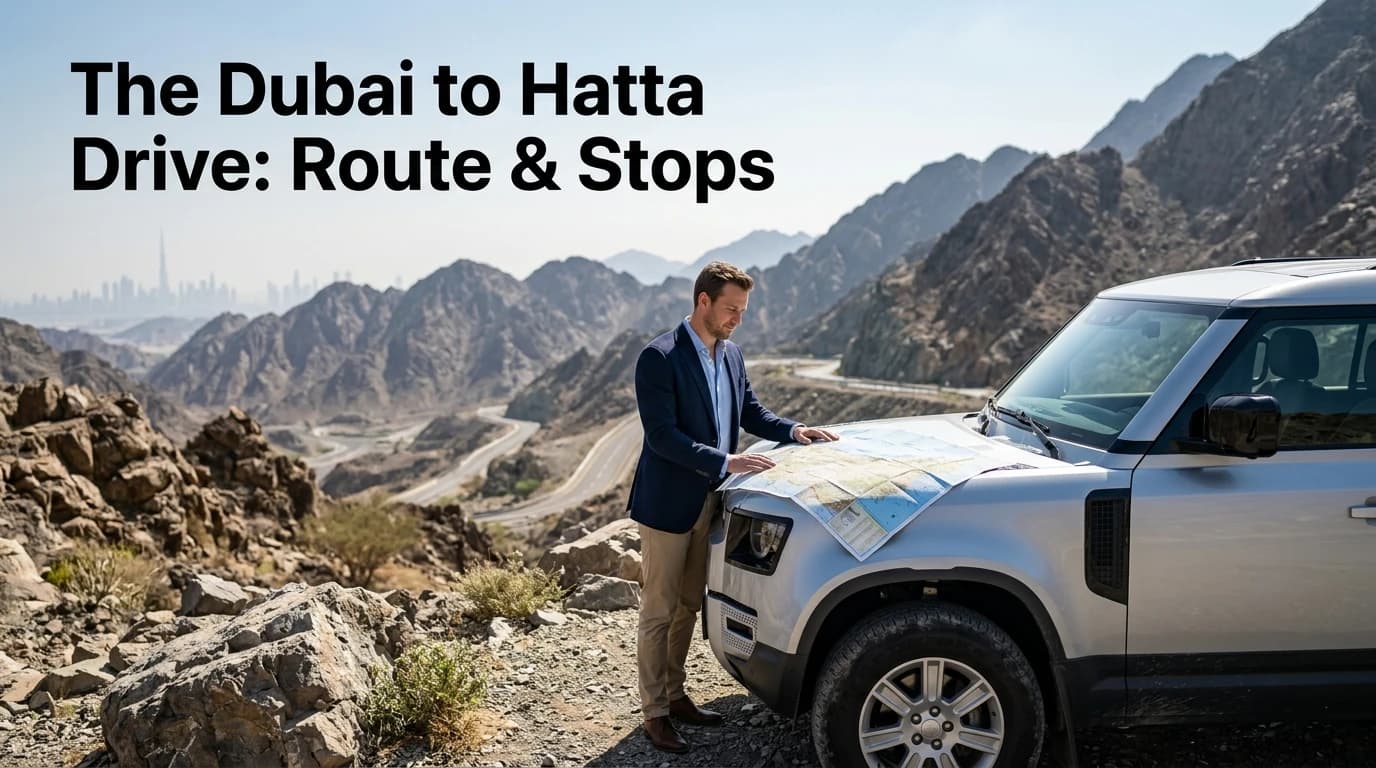
Hatta sits about 130 km east of central Dubai, and the drive takes roughly 90 minutes if you leave before the morning rush. The good news for first-timers is that the modern route stays entirely inside the UAE, so you can skip the passport worry that older guides still mention. This is a mountain run, not a highway cruise to a mall, so the road, the stops, and the car you pick all matter more than usual. Here is how to plan the day so you arrive with time to actually do something.
The route, and the border crossing you no longer need
For years the quickest line to Hatta cut through a small piece of Omani territory, which meant a passport check both ways and the occasional surprise if your paperwork was off. You can ignore all of that now.
The route most people take is E611 (Emirates Road) heading toward Sharjah, then E102 east toward Kalba and Manama, then a turn south onto E44 toward Hatta after the town of Shawka. That sequence keeps you on UAE soil the whole way and skips the old enclave completely. The signs are clear and bilingual, so you are mainly following the word Hatta once you are past Shawka.
The older, more direct E44 line from Al Aweer is shorter on paper but runs closer to the enclave and through more open desert with fewer services. Unless you have a specific reason to take it, the E611 to E102 approach is the easier, more comfortable drive, and the time difference is small.
One detail that surprises people: there are no Salik gates on this route. Salik charges AED 6 per gate inside the city, but the road out to Hatta does not pass any of them, so your only running cost is fuel.
Fuel up before the desert thins out
Stations are everywhere on the way out of Dubai and then get scarce as you climb. There are stops around Lahbab and near Madam and Shawka, but they thin out the closer you get to the mountains. Fill the tank before you leave the city or at the last big station on the outskirts. Hatta town itself has fuel, so this is about the middle of the drive, not the destination.
If you are running the air conditioning hard in summer and climbing grades, a small tank empties faster than you expect. Starting full removes the only real logistics worry of the day.
What to break the drive for
The first half is open desert and dunes, flat and fast. It is not a scenic stretch so much as a warm-up, though the dune fields near Lahbab are worth a window-down look if it is your first time out of the city. Save your stops for the back half, where the landscape changes into proper jebel country and the road starts to bend and climb.
The real reason to slow down is that the mountains arrive suddenly. One minute you are on flat scrub, the next you are among dark rock ridges, and that transition is the best part of the approach. Take it at a relaxed pace rather than pushing for a time.
Hatta Dam, the centrepiece
The dam is what most people come for, and it earns it. A turquoise reservoir sits between bare mountains, and the contrast of that colour against the rock is the photograph everyone takes. Parking is straightforward and the viewpoints are an easy walk.
Kayaking is the thing to do here. You rent a kayak or pedal boat at the water's edge and paddle out across calm water with the ridges reflected on the surface. Expect to pay roughly AED 60 to 120 depending on the boat and the session, and to spend 30 to 45 minutes on the water. The site runs first come, first served rather than on bookings, with morning and early-afternoon sessions, so arriving earlier means a shorter wait and cooler air.
Hatta Wadi Hub, if you want more than a viewpoint
A short drive from the dam, the Wadi Hub is the adventure side of Hatta. Mountain-bike trails graded from beginner to hard, a zip-line, archery, paddleboarding, bubble football, and a few oddities round out the day for anyone who does not want to just look at scenery. Entry tickets start at around AED 49, with individual activities priced on top.
This is the part of the trip that decides how long you stay. A quick dam visit plus lunch is a half-day. Add the Wadi Hub and you have a full eight or nine hours, which is the natural shape of a Hatta day trip.
The quieter stops worth a half hour
Two places reward a short detour. The Hatta Heritage Village is a reconstructed old settlement with watchtowers and traditional houses, free to enter, and a calm way to break up the activity. The Honeybee Garden and Discovery Centre, open daily, runs a guided look at hives and a tasting, which goes down well with kids and anyone curious about how all that Hatta honey is made.
Neither needs a booking, and neither needs more than half an hour, so they slot in between the bigger stops rather than competing with them.
When to go
The window for a comfortable Hatta day is October to April, when the mountain air is pleasant and the kayaking is genuinely nice rather than an endurance test. June through September is hard going. The dam still looks the same, but midday heat in the mountains is punishing, so an early start and a focus on the water rather than the bike trails makes more sense in summer. Weekday mornings beat weekends for parking and shorter kayak queues.
The car you actually want
This is the decision people get wrong. The cheapest economy hatchback will physically reach Hatta, but the climb up into the jebel, with the air conditioning fighting the summer heat, is exactly where an underpowered small car struggles. You feel it on the grades, and you feel it more with a full car and luggage.
A mid-size SUV is the sensible pick. You want proper power for the climbs, air conditioning that holds up in the heat, and the higher seating that makes the mountain bends more relaxed. Automatic, every time, for the stop-and-go on the way out and the gradients on the way in. You do not need a serious off-roader for any of the route described here, since it is all sealed road, so a comfortable two-wheel-drive SUV is the right balance of cost and capability.
If you would rather not take your own car up and down the mountain, you can rent an automatic mid-size SUV from us at 24baba and have it ready for the day. Either way, pick the car for the climb, not for the headline daily rate.
FAQ — Common Questions Answered.
How long does it take to drive from Dubai to Hatta?
The drive takes about 90 minutes from central Dubai in normal conditions, covering roughly 130 km. Leave before the morning rush and the run out of the city is quick. Traffic in Dubai itself is the only part that can add time, since the open road beyond Sharjah moves well.
Do I need a passport or to cross into Oman to reach Hatta?
No. The route via E611, E102, and E44 stays entirely inside the UAE and avoids the old Omani enclave that earlier routes passed through. You do not need a passport or any border paperwork for a normal Hatta day trip. Only the older, more direct line ran close to the crossing, and you do not need to take it.
Are there Salik tolls on the way to Hatta?
There are no Salik gates on the road out to Hatta, so the drive itself carries no toll. Salik charges AED 6 per gate, but those gates are inside the city on routes you will not use for this trip. Your only real cost on the day is fuel.
Can I do Hatta as a day trip from Dubai?
Yes, and most people do. A full day of eight or nine hours is enough for kayaking at the dam, a stop at the Heritage Village, and an activity or two at the Wadi Hub, with lunch in between. An early start gives you cooler air and shorter queues, especially in the warmer months.
What car should I rent for the Hatta drive?
A mid-size automatic SUV is the right choice for the mountain climbs and the heat. The whole route is sealed road, so you do not need a four-wheel-drive off-roader, but you do want power and strong air conditioning that the cheapest hatchback cannot reliably give you. Comfort on the gradients is worth the small step up in rate.