

How to choose the right rental car in Dubai
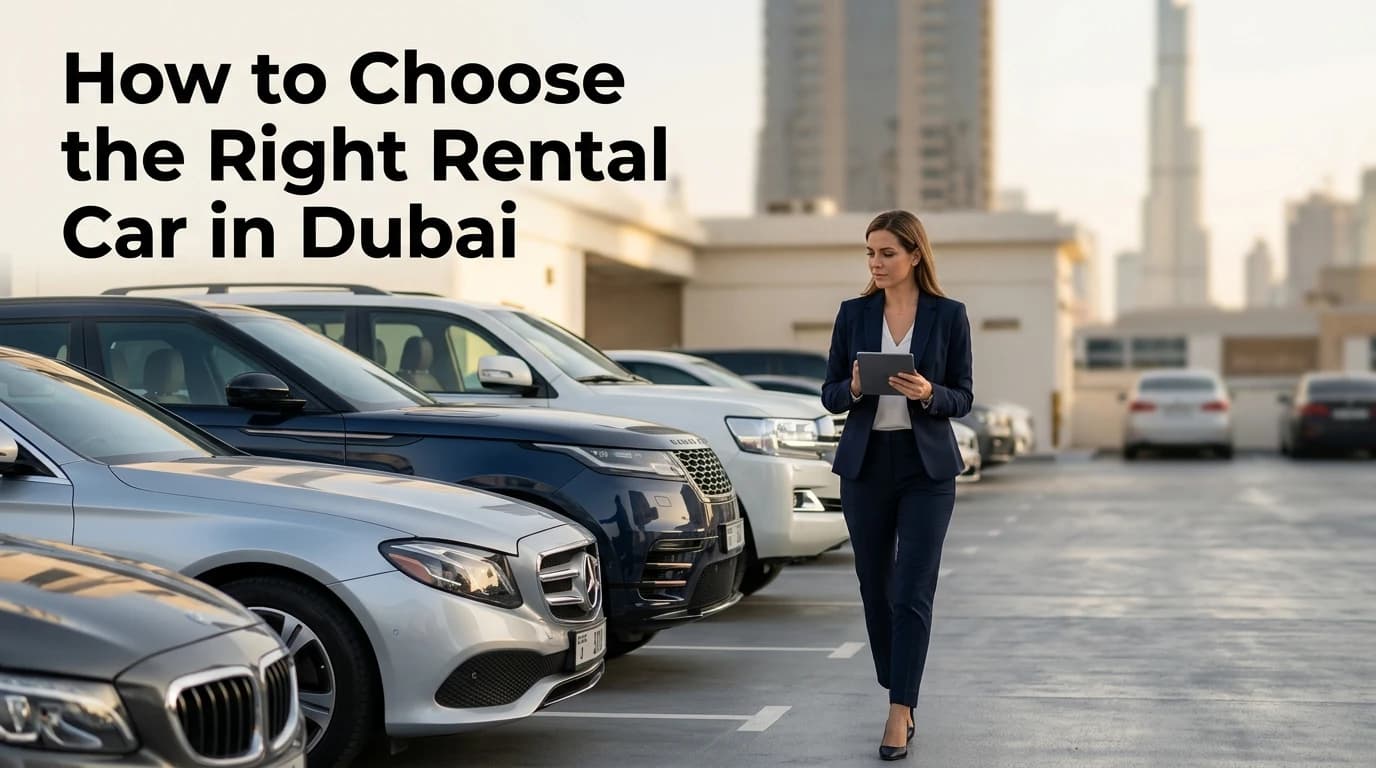
Most people booking a car for Dubai pick by price, regret it on day two, and spend the rest of the trip wishing they had read one more line on the booking page. The cheapest car is rarely the right car. The right car is the one that fits the driving you will actually do, the people and bags you are carrying, and the time of year you land. Get those three right and the price mostly sorts itself out.
This is the high-level decision, the one you make before you start comparing a sedan against an SUV or worrying about gearbox type. Work through the questions below in order, because each one narrows the next.
Start with the trip, not the car
The single biggest mistake is choosing a car for an imagined trip rather than the real one. Be honest about where you will drive.
If you are staying inside the city, hotel to mall to brunch to the marina, almost any car does the job, and a small one does it better. Parking in Downtown and JBR is tight, multi-storey ramps are narrow, and a compact car slots in where a big one does not. You will also pay less per day and burn less fuel crawling along Sheikh Zayed Road.
A road trip changes the answer. The run to Hatta, the climb up Jebel Jais near Ras Al Khaimah, or the long flat stretch to Abu Dhabi all reward a car with enough power to sit at 120 km/h without straining and overtake a slow truck without a deep breath. The Jebel Jais climb in particular punishes an underpowered engine. For those, step up in size and power even if the city would not need it.
The desert is its own case. If you are seriously planning to leave the tarmac, into the dunes at Al Qudra or out toward Liwa, you want a proper four-wheel-drive and, just as important, the off-road cover to match. Most standard rental insurance does not cover off-road driving, so a dune outing in a car that is not allowed off-road can leave you paying for the whole thing yourself. For 90 percent of visitors who say "desert", they actually mean a booked safari in someone else's car, and a normal vehicle is fine.
Count the people and the bags honestly
Numbers on a booking site lie a little. A car listed as five-seater seats five adults the way an economy flight seats you for fourteen hours: technically, not comfortably.
For two people travelling light, an economy car is genuinely all you need. For a couple with a week of luggage, check the boot, not the seat count, because a small hatchback that seats four can still swallow only two cabin bags. A family of four with a week of suitcases and a child seat is the point where a compact crossover or a mid-size starts earning its rate. Two adults, two kids and the luggage fit comfortably in a mid-size SUV with room to spare, and that spare room is the difference between a relaxed drive and repacking the boot in a car park.
Six or more people means a 7-seater, and here the honest version matters again. Many 7-seaters give you the third row only with the boot folded flat, so you get the seats or the luggage space, rarely both at full size. If you are six adults with bags, look at a larger van rather than a compact 7-seater.
Set a real budget, including the parts that are not the daily rate
Rental car prices in Dubai swing hard by category and season. As a rough guide for 2026, an economy hatchback sits around AED 90 to 150 per day, a comfortable mid-size sedan around AED 150 to 250, and a mid-size SUV around AED 200 to 350. Summer, roughly June through August, is low season for tourism, and daily rates often soften, so the same car can cost noticeably less in July than in January.
Weekly and monthly bookings change the maths completely. A car taken by the week usually drops the daily cost by 10 to 20 percent, and a monthly rate can land well below the daily equivalent, so if you are here for three weeks or more, ask for the monthly price even if you think you want it shorter.
Then there are the costs that do not appear in the headline rate, and these decide more bookings than the rate itself:
- Security deposit. A refundable hold on your credit card, usually AED 1,000 to 5,000 depending on the car. You need the headroom on your card for it, and it is released after you return the car clean and fine-free.
- Insurance excess. The amount you pay in an at-fault accident before cover kicks in. A car that looks cheap can carry a high excess, so a basic rate that saves you AED 30 a day is poor value if it comes with an AED 1,500 excess you would rather not risk.
- Salik tolls. Dubai's road tolls run AED 6 per gate at peak times, AED 4 off-peak, and are free between 1 am and 6 am. They are billed back to you at the end, so a city route that crosses several gates twice a day adds up.
- Fuel and mileage. Confirm the car comes with unlimited mileage rather than a daily cap, which matters a lot for road trips, and check the fuel policy so you are not charged a refill premium.
A cheap headline rate with a big excess and a low mileage cap can cost more than a slightly dearer car with everything included. Read those four lines before you read the price.
Don't skimp on air conditioning and power in summer
This is the one piece of advice every first-time summer visitor ignores once. From May to September, a Dubai afternoon can sit at 45 degrees Celsius or higher, and a tired engine in a bargain car struggles to cool the cabin and climb at the same time. The economy hatchback that is perfectly fine in February becomes a small oven idling at a Tecom traffic light in July.
For any summer trip beyond pure city pottering, step up to a car with an engine that does not labour and a climate system that actually keeps up. The Jebel Jais and Hatta climbs in summer are exactly where an underpowered car shows its limits, with the air conditioning fighting the gradient and losing. Pay the extra AED 50 a day. You will not regret it at noon in August.
Match the car to the driver, not just the trip
A few practical fits worth checking before you commit. Almost every rental in Dubai is automatic, which suits the stop-start traffic and is what most visitors expect, so you rarely have to think about gearbox unless you specifically want manual. If you are nervous about driving on multi-lane highways for the first time, a smaller, easier-to-place car builds confidence faster than a big SUV. And if you are arriving jet-lagged at DXB or DWC, a car with airport pickup waiting for you beats hunting for a desk at 2 am.
When the trip points to an automatic SUV with proper climate control, for the Hatta run or a family week, that is an easy car to book, and you can rent one from us at 24baba. Match the car to the three questions above first, then pick the company.
FAQ — Common Questions Answered.
What is the best type of rental car for a first-time visitor to Dubai?
For a first visit spent mostly in the city, a compact or economy car is the easiest choice. It parks easily in tight multi-storey garages, costs the least per day, and is simple to place on busy roads while you get used to driving here. Step up to a mid-size or SUV only if you are doing real road trips or carrying a family with luggage.
Do I need an SUV to rent a car in Dubai?
No, most visitors do not. A sedan or compact car handles city driving and paved road trips to Hatta, Abu Dhabi or the east coast perfectly well. You want an SUV mainly for extra luggage and passenger space, or a proper four-wheel-drive only if you genuinely plan to drive off-road in the desert, which most tourists do not.
How much should I budget per day for a rental car in Dubai?
In 2026, an economy car runs roughly AED 90 to 150 per day, a mid-size sedan AED 150 to 250, and a mid-size SUV AED 200 to 350. Summer rates are often lower, and weekly or monthly bookings cut the daily cost. Remember to budget for Salik tolls, fuel, and a refundable deposit of AED 1,000 to 5,000 on your card.
What hidden costs should I check before booking?
Check the insurance excess, the security deposit, the mileage policy, and the fuel terms. A low daily rate can hide a high excess of AED 1,500 or more, a daily mileage cap that hurts on road trips, or a costly fuel policy. Salik tolls of AED 4 to 6 per gate are also billed back to you at the end of the rental.