

Best day trips from Dubai by car
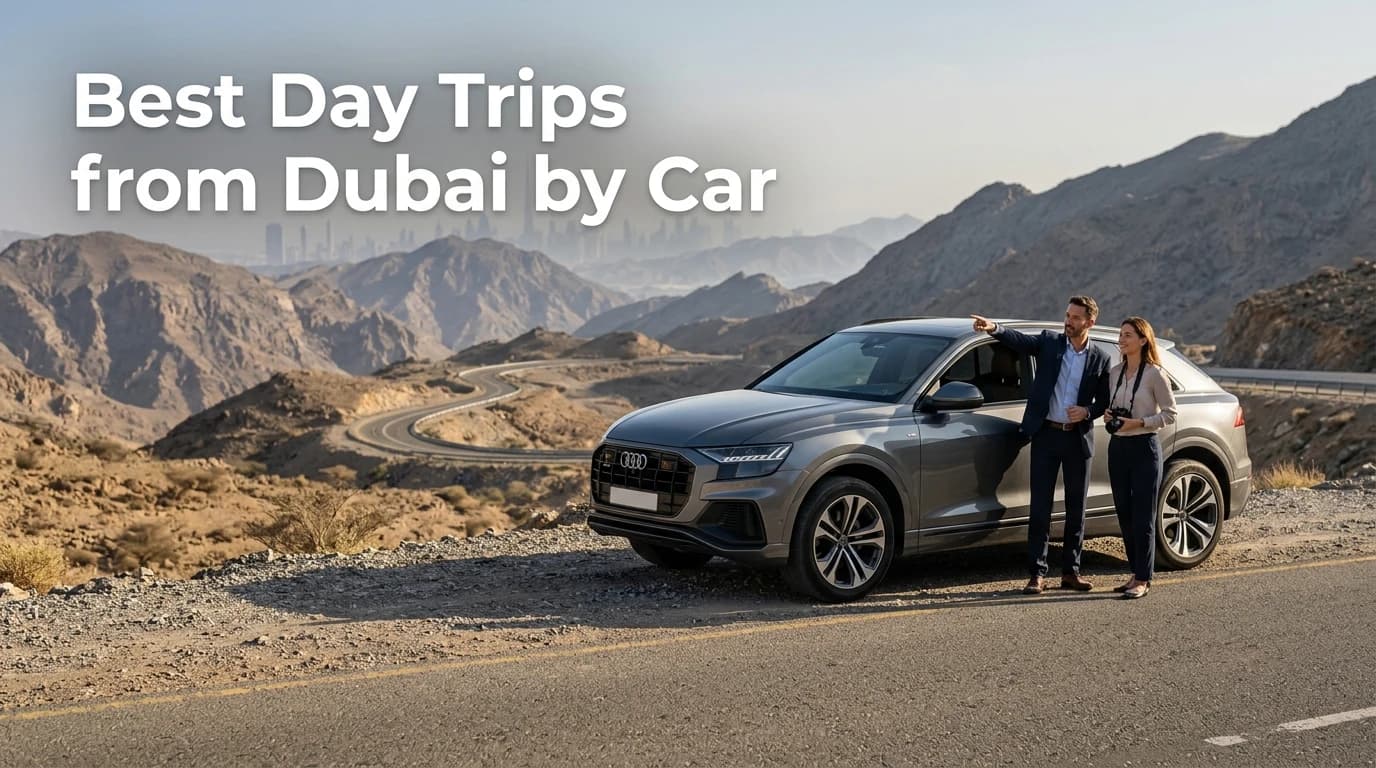
Most of the UAE sits within a two-hour drive of Dubai, which means a single tank of fuel and an early start can get you to a mountain summit, a quiet beach, or an oasis city and back before dinner. The trick is picking the right trip for the day you have and the car you are sitting in. A flat highway run to Abu Dhabi asks nothing of your vehicle. A climb up Jebel Jais in July asks for working air conditioning and an engine that does not strain on the gradient. Below are the day trips worth your time, roughly by distance from the city, with what each one costs in time, fuel and Salik, and the car I would actually take.
Al Ain, the garden city about 90 minutes east
Al Ain is the trip I send people on when they want something different from beaches and malls. It is roughly 135 km from central Dubai on the E66 (the Dubai to Al Ain Road), and the drive runs about an hour and 25 minutes with clear traffic. The road is straight and fast, so any car does it comfortably. There are no Salik gates on this route once you are heading out of the city, which keeps the cost down to fuel.
What you go for: the date palm oasis with its old falaj irrigation channels, the Al Jahili Fort, and Jebel Hafeet. That last one matters. The mountain road up Jebel Hafeet is one of the best driving roads in the country, about 11 km of smooth switchbacks to a summit with a long view over the city and the desert. A small hatchback will make it, but a car with a bit of power makes the climb more pleasant and a lot less noisy. Go in the cooler morning, do the oasis and a fort, then save the mountain for late afternoon when the light is better and the heat has dropped.
Abu Dhabi, the easy city day
Abu Dhabi is the simplest day trip on this list because it is one highway, the E11, and about 130 km from Dubai. With clear roads it is around 75 to 90 minutes, but the same trip during the weekday morning or evening rush stretches well past two hours, so leave Dubai before 7am or after 9:30am. Expect Salik on the way out of Dubai, AED 6 per gate at peak times and AED 4 off-peak in 2026, plus Abu Dhabi's own Darb toll gates as you enter the capital.
The Sheikh Zayed Grand Mosque is the obvious reason to go and worth the early start, with the Louvre Abu Dhabi and the Corniche filling out a full day. We have a separate guide to the Abu Dhabi run that covers parking, the Darb tolls and timing in more detail, so I will leave the depth there. Any car is fine for this one. It is a city day, not a driving day.
Hatta, the mountain town near the Oman border
Hatta sits about 130 km southeast of Dubai and takes around 90 minutes. It is an exclave of Dubai tucked into the Hajar Mountains, so you get dam views, the turquoise Hatta reservoir with its kayaks, and proper hill country without leaving the emirate. The newer E102 route through Sharjah and Kalba avoids the old border-checkpoint hassle, so check your navigation sends you that way.
For Hatta I would take a mid-size SUV rather than the cheapest hatchback. The climbs into the town are not technical, but you want the air conditioning to hold up and enough engine to take the gradients without complaint, especially with a few passengers and a cooler box in the boot. We cover Hatta in more depth elsewhere, including the kayak booking and the mountain bike trails, so treat this as the headline version.
The east coast: Fujairah, Khor Fakkan and Snoopy Island
This is the day trip I push hardest, because most visitors never think to cross to the other side of the country. The drive to Fujairah is around 120 km and roughly 90 minutes on the E84 (Sheikh Khalifa Highway), which cuts straight through the Hajar Mountains and is a genuine pleasure to drive. You cross from the Gulf to the Gulf of Oman, and the water on the east coast is clearer and calmer than anything on the Dubai side.
Make Khor Fakkan your main target. It has a proper public beach, a corniche, the waterfall amphitheatre, and Snoopy Island just offshore, which is the best easy snorkelling near Dubai. You can hire mask and fins on the beach and swim out to the reef. Fujairah city adds the old fort and the Friday market on the Masafi road, where you stop for fruit, carpets and pottery on the way. A full loop out via Fujairah and back through Masafi and Dhaid makes a satisfying circle rather than an out-and-back.
A normal sedan handles the whole route. The mountain highway is well paved with no rough sections. What I would say is fill up before the mountains and carry water, because stretches of the E84 are remote and the petrol stations thin out. If you want to add the Wadi Wurayah area or any unpaved track off the main road, switch to an SUV with decent ground clearance. On tarmac, though, you do not need one.
Jebel Jais, the highest road in the UAE
Jebel Jais in Ras Al Khaimah is the long day, about 175 to 180 km and two to two and a half hours each way, so it works best as a single big outing rather than something you tack onto another stop. Take the E311 or E611 north out of Dubai, then the marked mountain road up from Ras Al Khaimah. The summit road climbs to roughly 1,900 metres, the air is noticeably cooler than the coast, and in winter it genuinely drops near freezing at the top.
This is the one trip where the car really matters. The road is fully paved and safe for an ordinary sedan, but it is a long, sustained climb, and a gutless economy car struggles on the gradient and runs its air conditioning hard the whole way up. A mid-size SUV or a sedan with a decent engine makes the climb easy and keeps the cabin cool. There is one critical rule: fill your tank in Ras Al Khaimah city or at the ADNOC station at the foot of the mountain, because there is no fuel once you start climbing. Up top you have the viewpoints, the world's longest zipline, the via ferrata, and a few cafes. Aim to be heading down before dark, since the descent is more demanding than the climb.
A note on the desert and on Oman
Two trips deserve a mention but not a deep dive here. A desert drive into the dunes near Al Qudra or out toward the Sweihan sands is a half-day rather than a long haul, but it needs a proper four-wheel-drive and the know-how to deflate tyres and read soft sand. Do not take a rented sedan off the tarmac. We have a full desert-driving guide for that.
Musandam, the Omani peninsula north of Ras Al Khaimah, is the other one. The dhow cruises out of Khasab are spectacular, but it is a border crossing into Oman, which means your insurance needs an Oman extension and you should treat it as a planned trip, not a spontaneous day out. Our Oman-border guide walks through the paperwork.
Picking the right car for the drive
The pattern across all of these is simple. City days like Abu Dhabi take any car. Coastal and oasis runs on good tarmac are fine in a comfortable sedan. The sustained mountain climbs to Jebel Jais and the Jebel Hafeet road, and anything with passengers and luggage in summer, are where a mid-size SUV with strong air conditioning earns its keep. Only the dunes need a genuine four-wheel-drive. When you are matching the car to the trip, you can rent the right one from us in Dubai at 24baba and pick it up before your early start.
FAQ — Common Questions Answered.
Do I need a four-wheel-drive for any of these day trips?
No, not for the tarmac routes. Al Ain, Abu Dhabi, Hatta town, the east coast and the Jebel Jais summit road are all fully paved and fine for a normal car. You only need a four-wheel-drive if you plan to leave the asphalt and drive on sand or unpaved wadi tracks, which is its own kind of trip with its own preparation.
How much should I budget for Salik and tolls on a day trip?
It depends on the direction. Trips that take you out through Dubai's Salik gates cost AED 4 to 6 per crossing in 2026, depending on the time of day, and you usually pass only one or two on the way out. The Abu Dhabi run adds the capital's Darb gates on top. The east coast and Al Ain routes head away from most of the Dubai gates, so tolls there are minimal. Fuel is the bigger cost on the longer drives.
Which day trip is best with kids?
The east coast wins for families. Khor Fakkan has a calm, shallow public beach, snorkelling at Snoopy Island that older children can manage, and a short enough drive that nobody melts down in the back seat. Al Ain is a good second choice for its zoo and the easy oasis walks. Save Jebel Jais for when the children are old enough to handle a long drive and a cool, high summit.
When is the best time of year for these drives?
October to April is the comfortable window for everything, especially the mountain trips and any beach time. In the summer months the heat makes long drives and outdoor stops harder, though the higher altitude at Jebel Jais stays cooler than the coast. Whatever the season, start early to beat both the traffic and the worst of the midday heat, and carry plenty of water.