

Driving from Dubai to Abu Dhabi: route, time and tolls
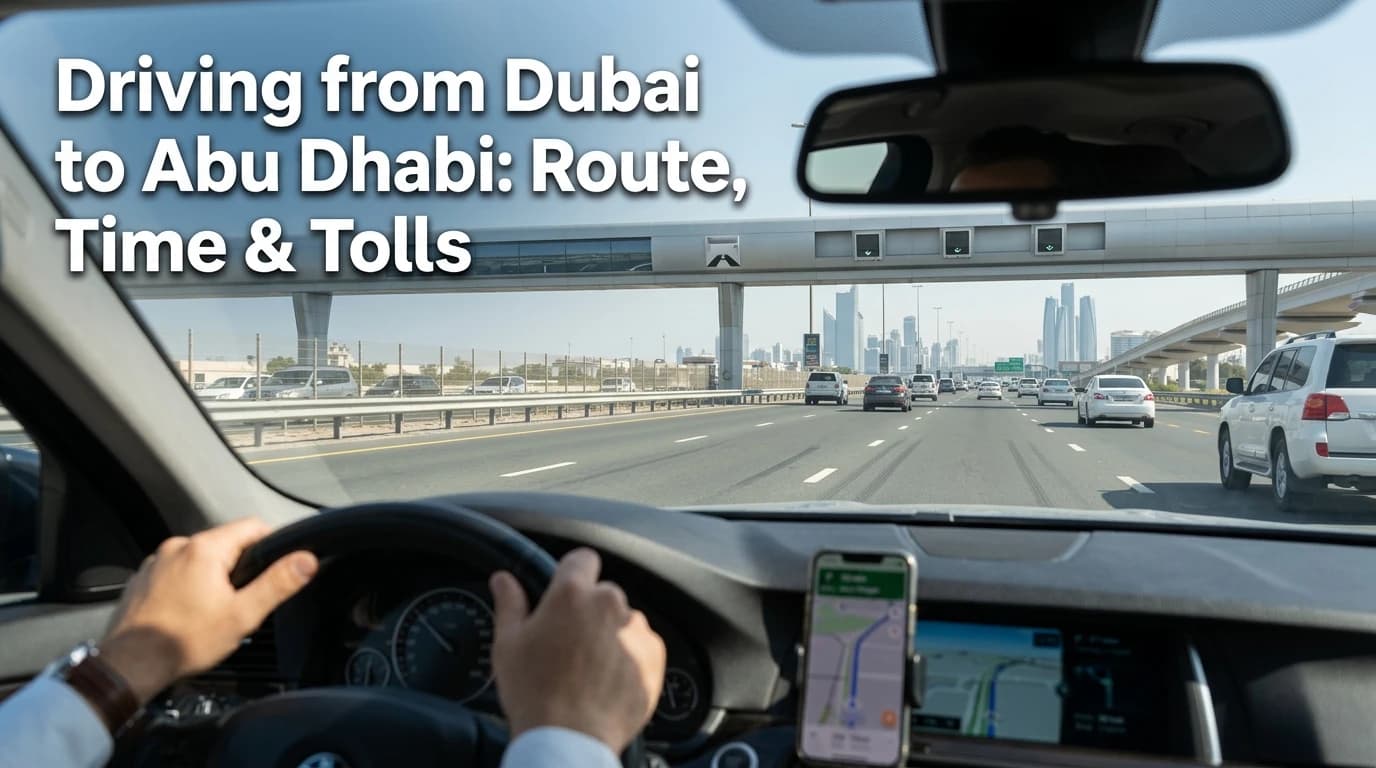
The drive between the two cities is about 140 to 150 km, and on a clear run it takes a little over 90 minutes door to door. That number hides a lot, though. The same trip can stretch to two and a half hours if you hit the evening crush leaving Dubai, and the toll picture changed twice in the past year. This guide walks the route the way you will actually drive it, from the Sheikh Zayed Road on-ramp to a parking spot on Abu Dhabi island, with the costs and rules that catch people out.
The route you want: stay on the E11
You barely need a map for this one. The whole trip is essentially one road, the E11, which is Sheikh Zayed Road as it leaves Dubai and becomes Sheikh Maktoum bin Rashid Road on the Abu Dhabi side. Get on the E11 heading southwest, keep going, and follow the signs for Abu Dhabi. Most navigation apps will try to put you here anyway.
There is a slightly faster alternative for some trips. The E311 (Sheikh Mohammed bin Zayed Road) runs parallel and inland, and it skips the coastal traffic around Jebel Ali. If you are heading to Yas Island, the airport, or Saadiyat rather than the city centre, the E311 or a combination of the two can save you ten or fifteen minutes. For a first visit aiming at the Corniche or the Grand Mosque, the E11 is the simpler call and the one this guide follows.
What it actually costs in tolls
Two separate systems sit on this route, and you pay both. Dubai runs Salik, Abu Dhabi runs Darb, and the accounts do not talk to each other.
On the way out of Dubai you pass through Salik gates depending on where you start. Each Salik crossing is AED 4, charged automatically, every day, all hours. If you begin in Dubai Marina or further out toward Jebel Ali, expect one or two Salik charges before you clear the city.
Abu Dhabi's Darb is where it gets fiddly, because the rules differ by gate.
- The newer Ghantoot gate sits on the E11 right near the Dubai border, and it went live on 4 May 2026. It charges AED 4 on every single crossing, 24 hours a day, seven days a week, with no free periods. If you drive the E11, you pay this one, full stop.
- The four original gates are on the bridges onto Abu Dhabi island: Sheikh Zayed Bridge, Sheikh Khalifa Bridge, Al Maqta Bridge, and Mussafah Bridge. These only charge AED 4 during peak hours, which are 7:00 am to 9:00 am and 3:00 pm to 7:00 pm, Monday to Saturday. Outside those windows, and all day Sunday, they are free.
Time your crossing onto the island for the middle of the day or a Sunday and you skip the bridge toll entirely. The Ghantoot charge you cannot dodge. One more thing worth knowing: the old AED 16 daily cap was scrapped on 1 September 2025, so there is no longer a ceiling on what you rack up in a day.
How tolls work in a rental car
This trips up almost every first-timer, so here is the short version. You do not need a Salik tag or a Darb account in a rental. The rental company keeps the car registered on both systems, and every gate you pass is logged against the plate. After you return the car, the charges come back to you, usually billed to the card on file, and most companies add a small administration fee per toll on top of the AED 4. So a day trip to Abu Dhabi might show up later as the toll total plus a handful of dirhams in handling. Nothing to set up, nothing to top up, but worth expecting on the final statement rather than being surprised by it.
Speed limits, and the warning that matters most
The E11 is a fast, well-built highway, and the temptation to push it is real. Resist it once you cross into Abu Dhabi.
Leaving Dubai, Sheikh Zayed Road runs at 100 to 120 km/h depending on the section, shown on the overhead gantries. Dubai gives you a 20 km/h buffer before a speed camera triggers, which most drivers quietly rely on.
Abu Dhabi does not. The emirate enforces the posted limit with zero tolerance. There is no buffer. If the sign says 120 and you are doing 121, the camera can catch you. The limit on the main Abu Dhabi stretch of the E11 dropped from 160 to 140 km/h on 9 February 2026, so even the fast section is slower than it used to be. The practical rule: watch the gantry signs, and the moment you are in Abu Dhabi territory, sit on or just under the posted number. A speeding fine in Abu Dhabi on a rental will find its way back to you the same way the tolls do, with the same admin fee attached.
Fuel and a sensible stop
You do not need to plan fuel around this drive. A full tank covers the round trip with room to spare, and petrol stations line both the E11 and E311 the whole way. ADNOC and ENOC are the names you will see most. Fuel is cheap by most visitors' standards, and pumps are full service, so an attendant fills the car while you stay put.
If you want a break, the stretch around Ghantoot and Yas Island has the usual service stops. Yas Mall is an easy detour if you are travelling with kids who need to burn off an hour, and it sits right by the theme parks if that is where you are headed anyway.
Parking once you arrive
Abu Dhabi runs paid street parking under the Mawaqif system across most of the city, marked by blue and white kerb lines for standard bays and black and white for residents only. You pay at the machine or through the Darb app, and rates are modest, roughly AED 2 to 3 per hour in standard zones, with premium areas charging more. Parking is free on Sundays and public holidays in most standard zones.
For the big attractions, you are usually better off in a proper car park. The Sheikh Zayed Grand Mosque has a large free visitor car park, and the malls offer free covered parking that is a relief in summer. If you are heading to the Corniche, aim for one of the paid lots rather than circling for a street bay on a busy weekend.
What to actually do when you get there
A day trip realistically fits two or three things, not a checklist. The Sheikh Zayed Grand Mosque is the one nearly everyone comes for, and it deserves the visit. Go early or late to dodge both the heat and the coach crowds, and dress modestly since it is an active place of worship. The Corniche is the easy second stop, a long waterfront stretch good for a walk or a coffee, and it is genuinely pleasant in the cooler months.
Families tend to point at Yas Island instead, where Ferrari World, Warner Bros. World and Yas Waterworld sit close together. Pick one park per visit rather than trying to do two. For something quieter, Louvre Abu Dhabi on Saadiyat Island is a half-day on its own and a good call when the weather pushes you indoors.
For the Grand Mosque and Corniche run, an automatic SUV with proper climate control is the comfortable pick for the highway miles, and you can rent one in Dubai from us at 24baba before you set off.
FAQ — Common Questions Answered.
How long does it take to drive from Dubai to Abu Dhabi?
Plan for about 90 minutes to two hours under normal conditions, covering roughly 140 to 150 km on the E11. Leaving Dubai during the evening rush, between about 5:00 pm and 7:00 pm, can push it closer to two and a half hours. The smoothest runs are mid-morning or early afternoon outside peak windows. Always check live traffic before you leave, since one incident on the highway changes the picture quickly.
Do I pay tolls driving from Dubai to Abu Dhabi?
Yes, you pay on both systems. Dubai's Salik charges AED 4 per gate as you leave the city, and Abu Dhabi's Darb charges AED 4 at the Ghantoot gate near the border on every crossing, any time of day. The four bridge gates onto Abu Dhabi island only charge AED 4 during peak hours on weekdays and Saturdays, and are free off-peak and all day Sunday. In a rental, all of this is billed back to you after the trip.
Are tolls free at any time of day?
Partly. The Ghantoot gate on the E11 charges around the clock with no free periods, so you always pay AED 4 there. The original four island gates are free outside peak hours, meaning before 7:00 am, between 9:00 am and 3:00 pm, after 7:00 pm, and all day every Sunday. Timing your crossing onto the island for off-peak hours saves you the bridge charge but not the Ghantoot one.
What is the speed limit and is there a buffer?
Sheikh Zayed Road out of Dubai runs at 100 to 120 km/h, and the main Abu Dhabi section of the E11 is now 140 km/h after the change in February 2026. The critical difference is enforcement. Abu Dhabi applies zero tolerance with no speed-camera buffer, so you can be fined for even one kilometre over the posted limit. Watch the gantry signs and sit on or under the number once you cross into Abu Dhabi.
How do tolls and fines work on a rental car?
You do not set up anything yourself. The rental company keeps the car registered for both Salik and Darb, so every gate is logged automatically against the plate. After you return the car, the tolls are charged to your card on file, usually with a small per-toll administration fee. Any speeding fine from the trip comes back the same way, so drive to the limit and time your crossings to keep the total down.