

Is it safe to drive in Dubai as a tourist?
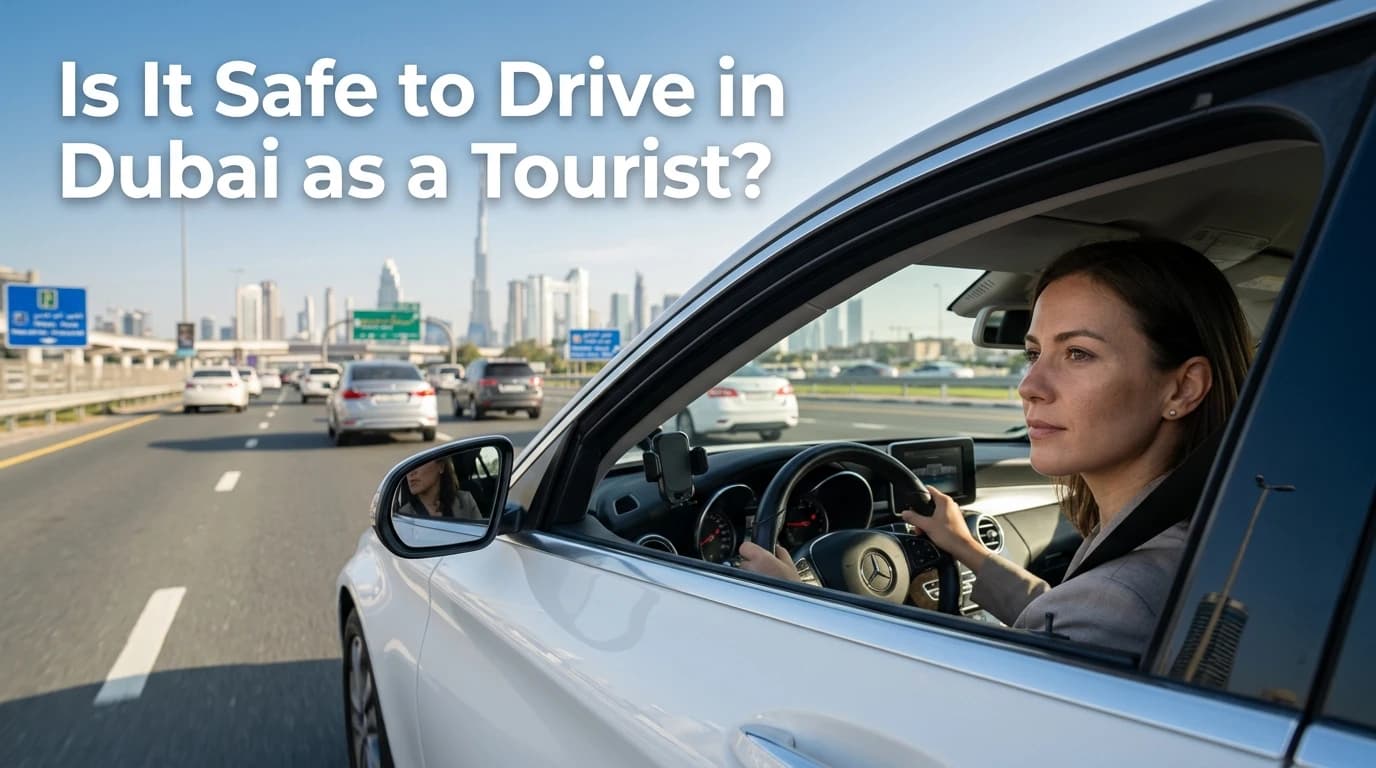
Short answer: yes, and most visitors take to it faster than they expect. The roads are wide, well signed in English and Arabic, and lit better than almost anywhere you have driven at home. Dubai also drives on the right, so anyone coming from Europe, the Americas or most of Asia is already on the correct side. Road deaths here have fallen sharply over the past two decades, helped by heavy camera enforcement.
The honest part is the bit nobody warns you about: the pace. Traffic moves fast and confidently, lane discipline is loose, and a six-lane interchange at full speed is a different thing from your local ring road. None of it is dangerous if you know what you are walking into. This is what to expect.
What is genuinely easy
The infrastructure does a lot of the work for you. Sheikh Zayed Road, the spine of the city, is a smooth multi-lane highway with clear overhead gantries telling you which lane goes where well before the exit. Surface streets are in good condition, parking is plentiful if you pay for it, and fuel is cheap and everywhere.
Navigation is straightforward too. Google Maps and Waze both work well here, traffic data is accurate, and the lane guidance is usually right. Keep your phone mounted and the sound on, because you will want the spoken cue for exits that come up quickly.
You also do not need to learn a new licence system on arrival. If you hold a licence from a recognised country, including the UK, the US, Canada, Australia and most of Western Europe, you can rent and drive on that licence as a tourist. If your licence is from elsewhere, or is not in English or Arabic, you need an International Driving Permit alongside it, and you have to arrange that in your home country before you fly. You cannot get one in Dubai as a visitor.
What actually trips people up
A few things consistently catch first-timers, and none of them are obvious from the brochure.
The speed is the big one. Limits run from 40 km/h in residential areas to 120 km/h on the main highways, and 140 km/h on some outer roads where it is signed. The catch is the unwritten habit: Dubai applies a buffer, so a camera on a 100 km/h road usually only triggers at 121 km/h. Locals drive to that buffer, not to the sign. So the real flow of traffic sits well above what the sign says, and if you sit at the posted number in the fast lane you become the obstacle. Stay right unless you are actively overtaking.
Lane changes are the second thing. Drivers here switch lanes assertively and often without much warning, and tailgating in the fast lane is common. The fix is simple and it is the same fix that works at home: leave a bigger gap than feels necessary, mirror-check constantly, and do not treat the left lane as a cruising lane.
Then there are the interchanges. Junctions like the one where Sheikh Zayed Road meets Al Khail can throw four or five exit options at you in quick succession across several lanes. Miss your exit and the next U-turn can be a long way off. The answer is to get into the correct lane early, the moment the GPS tells you, rather than at the last second.
Summer adds one more. From roughly June to September the glare and heat are brutal. Low sun at dawn and dusk can wash out the road, so carry sunglasses and keep a safe following distance for the moment you are briefly blinded. When fog or rain rolls in, usually in winter mornings, the RTA drops the highway limits on the overhead signs and often removes the speed buffer entirely, so the displayed number becomes the hard limit. Slow down when you see those signs change.
The money side, so nothing surprises you
Salik, the toll system, is automatic. There are no booths and no slowing down. You simply drive under a gantry and the charge is logged, AED 6 per crossing during peak hours and AED 4 off-peak, with a small VAT added on top from June 2026. On a rental, those tolls get billed back to you, usually against the card on your booking, so there is nothing to set up.
Fines work the same way. Cameras catch speeding, mobile phone use, tailgating and running lights, and a speeding fine starts at around AED 300 and climbs steeply with the offence. With a rental car the fine lands on the company first and then on your card, often with a small admin fee, so it pays to drive sensibly rather than gamble on the buffer.
One thing worth checking before you book is the insurance excess. A rate that looks cheap can carry an excess of AED 1,500 or more, meaning that is what you pay out of pocket if anything happens. Paying a little more for a lower excess, or adding Super CDW, is usually worth it for a visitor driving unfamiliar roads.
So, should you drive?
For getting around the city, the airport, the malls and day trips out to Hatta or the east coast, driving is the easiest way to do it, and a tourist who drives carefully at home will be fine here within a day or two. If your trip is purely Downtown and the Marina, the Metro and taxis may be simpler and you can skip the parking hassle. The decision really comes down to how far you want to roam.
If you do drive, an automatic with proper air conditioning is the sensible pick for the heat, and you can rent one from us at 24baba with airport pickup at DXB or DWC. Give yourself the first drive in daylight, keep right, and the rest follows.
FAQ — Common Questions Answered.
Do I need an International Driving Permit to drive in Dubai as a tourist?
It depends on your nationality. If you hold a licence from a recognised country such as the UK, US, Canada, Australia or most of Western Europe, you can drive on your home licence as a visitor. For other nationalities, or for licences not written in English or Arabic, you need an International Driving Permit alongside your original licence, and you must obtain it in your home country before traveling, since visitors cannot get one inside the UAE.
Is the speed limit buffer in Dubai real?
Yes, on most roads. Speed cameras generally trigger about 20 km/h above the posted limit, so a camera on a 100 km/h road usually activates at 121 km/h. The buffer is not guaranteed everywhere, though. Some residential and smart zones enforce the exact limit, and during fog or rain the RTA lowers the displayed limit and often removes the buffer, so do not rely on it as a rule.
What happens to traffic fines and tolls on a rental car?
Both are handled automatically and billed to you. Salik tolls are logged as you pass under the gantries and charged back, usually to the card on your booking. Speeding and other camera fines are issued to the rental company first and then passed to you, often with a small administrative fee. You will not be stopped at the roadside for these, but they will appear on your card, so drive as if every camera is live.
Is it safe to drive at night in Dubai?
Yes. The main roads are very well lit and night traffic is lighter than the daytime rush, which many visitors find easier. The main thing to watch is the same fast, assertive driving you see by day, plus the occasional vehicle moving well above the flow. Keep right, leave room, and you will be comfortable.