

Dubai Rental Car Fuel Policy: How Full-to-Full Works
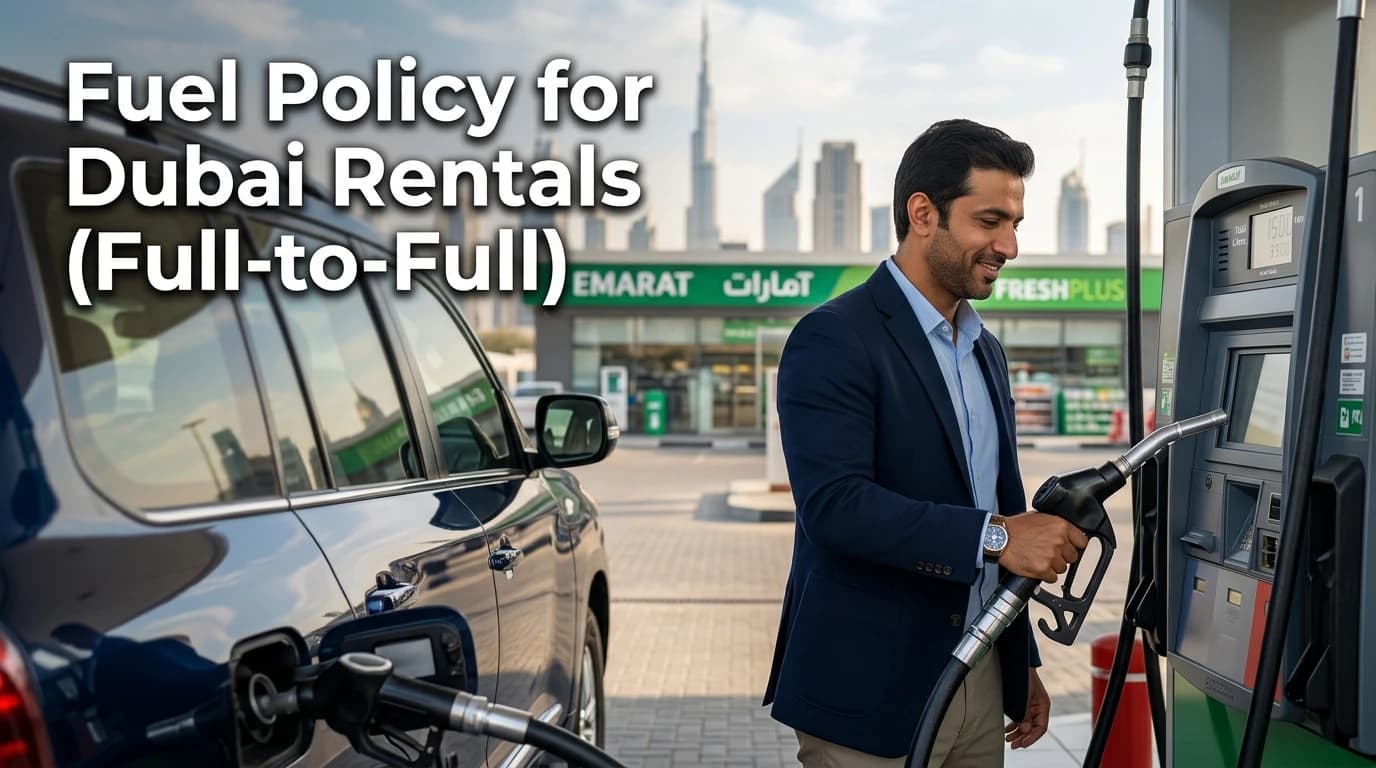
The line on your rental agreement that decides whether you overpay for fuel is the fuel policy, and most visitors sign it without reading it. Get it wrong and you can hand back a half-full tank, then watch the rental company bill you double the pump price for the petrol you used. This guide explains what full-to-full means, how it stacks up against the other policies you might be offered, which one is actually fair, and the ten-minute habit that keeps the refuelling charge off your final bill.
First, the number that frames everything. In June 2026 the UAE government set Special 95 at AED 3.83 per litre, Super 98 at AED 3.95, and E-Plus 91 at AED 3.76. Diesel sits at AED 4.33. Those rates are the same at every station in Dubai, Abu Dhabi and the rest of the country, because the price is set nationally each month. So fuel itself is cheap and fixed. The money you lose, when you lose it, is the rental company's markup, not the petrol.
The three policies you will actually be offered
There are really only three you need to recognise. Most reputable Dubai companies use the first one.
- Full-to-full. You collect the car with a full tank and return it full. You pay for exactly what you burn, at the pump, on your own card. Nothing changes hands on fuel at the desk.
- Full-to-empty (sometimes called prepaid fuel). You pay for a full tank up front and bring the car back as empty as you dare. You almost never time it right, so you donate the leftover fuel back to the company for free.
- Same-to-same. You return the car at the same level it left at, a quarter, a half, whatever the gauge showed. It sounds flexible but it is hard to match by eye and easy to dispute.
Full-to-full is the fairest of the three, and it is not close. You pay the regulated pump price for the petrol you used and not a dirham more. Full-to-empty only wins if you can run the tank to fumes on your last day, which no sensible person does in a city where you still need to reach the airport. Same-to-same leaves too much to interpretation at handover.
Where the charge actually bites
The trap with full-to-full is the return condition, not the policy itself. If you bring the car back under full, the company refills it for you and bills you at its own rate. That rate is the problem.
Refuelling charges in Dubai usually run 30 to 50 percent above the pump, and some firms stack a flat service fee on top. Rates of around AED 5 per litre for the missing fuel are common, and a few companies add a service surcharge of roughly 25 percent over the fuel cost. So a tank you could have topped up for AED 40 to 80 at a station can land as AED 100 or more on the bill. You are not paying for petrol at that point. You are paying for the inconvenience of making them do it.
Watch the prepaid upsell too. The desk may offer to sell you a full tank at booking, pitched as one less thing to think about. Unless you genuinely plan to return the car bone dry, you are pre-paying for fuel you will leave behind.
How to never see the refuelling charge
The fix takes ten minutes and one receipt.
- Fill the tank to the click at a station near the drop-off point, not halfway across town. The gauge needs to read full when the car is handed back.
- Keep the fuel receipt. It is timestamped and shows the litres, which settles any argument about whether the tank was really full.
- Snap a quick photo of the fuel gauge and the odometer right before you return the car. Two seconds, total protection.
- Match the grade the car was given. If it took Special 95, refill with 95. There is no reason to pay for Super 98 unless the car asks for it.
Petrol stations are easy to find and almost all run 24 hours. ENOC and EPPCO are the Dubai-side networks, ADNOC is the Abu Dhabi brand you will see everywhere too, and Emarat fills in the gaps. Most ENOC and EPPCO forecourts are full service, so an attendant pumps for you while you stay in the car. ADNOC has rolled out self-service smart pumps at some sites where you pay by card or app. Either way, ask for "full tank" and you are done.
For visitors there is one extra wrinkle. You do not pay at the pump in advance the way you might at home. The attendant fills the amount you ask for and you pay after, by card or cash, so just say full and settle up.
The short version
Take the full-to-full policy when it is offered, refuse the prepaid full tank unless you have a real reason for it, and fill up near the airport on your way back. Do that and the only fuel money you spend is the regulated pump price, which in June 2026 means AED 3.83 a litre for the Special 95 most cars run on.
When you book a rental car with us at 24baba, the car comes to you full and you simply return it full, so the fuel side of the rental stays as simple as one stop on the way to the airport. You can sort that out at 24baba.
FAQ — Common Questions Answered.
What does full-to-full mean on a Dubai car rental?
It means you collect the car with a full fuel tank and return it with a full tank. You buy only the fuel you actually use, at the regulated pump price, paying the station directly. The rental company does not charge you for fuel at all as long as the gauge reads full on return. It is the most common and the fairest policy used by reputable Dubai rental firms.
Is full-to-full or full-to-empty cheaper?
Full-to-full is almost always cheaper for normal use. With full-to-empty you prepay for a whole tank and then leave behind whatever you do not burn, which is usually a fair amount because nobody wants to risk running dry before reaching the airport. Full-to-full lets you pay for exactly what you used at AED 3.83 a litre for Special 95. You only lose with it if you forget to refill before handing the car back.
How much do Dubai rental companies charge if I return the car not full?
Expect to pay 30 to 50 percent above the pump price, and sometimes a flat service fee on top. A common figure is around AED 5 per litre for the missing fuel, and some firms add a service surcharge of about 25 percent. A top-up that would cost you AED 40 to 80 at a station can become AED 100 or more on your bill. Refilling yourself before return avoids the markup entirely.
Where should I refuel before returning a rental car in Dubai?
Use any ENOC, EPPCO, ADNOC or Emarat station close to your drop-off point, ideally within a few minutes of it. Most are open 24 hours, so timing is rarely a problem even for a late return. ENOC and EPPCO are typically full service with an attendant, while ADNOC offers some self-service smart pumps. Fill the tank to full, keep the receipt, and photograph the gauge before you hand the keys back.
Which fuel grade should I put in a rental car?
Use the grade the car was supplied with, which for most economy and mid-range rentals is Special 95. The fuel cap or door usually states the minimum grade required. There is no benefit to paying for Super 98 unless the vehicle specifically calls for it, and at AED 3.95 versus AED 3.83 a litre it just costs you a little more for nothing.