

Driving Rules in Dubai Every Visitor Should Know
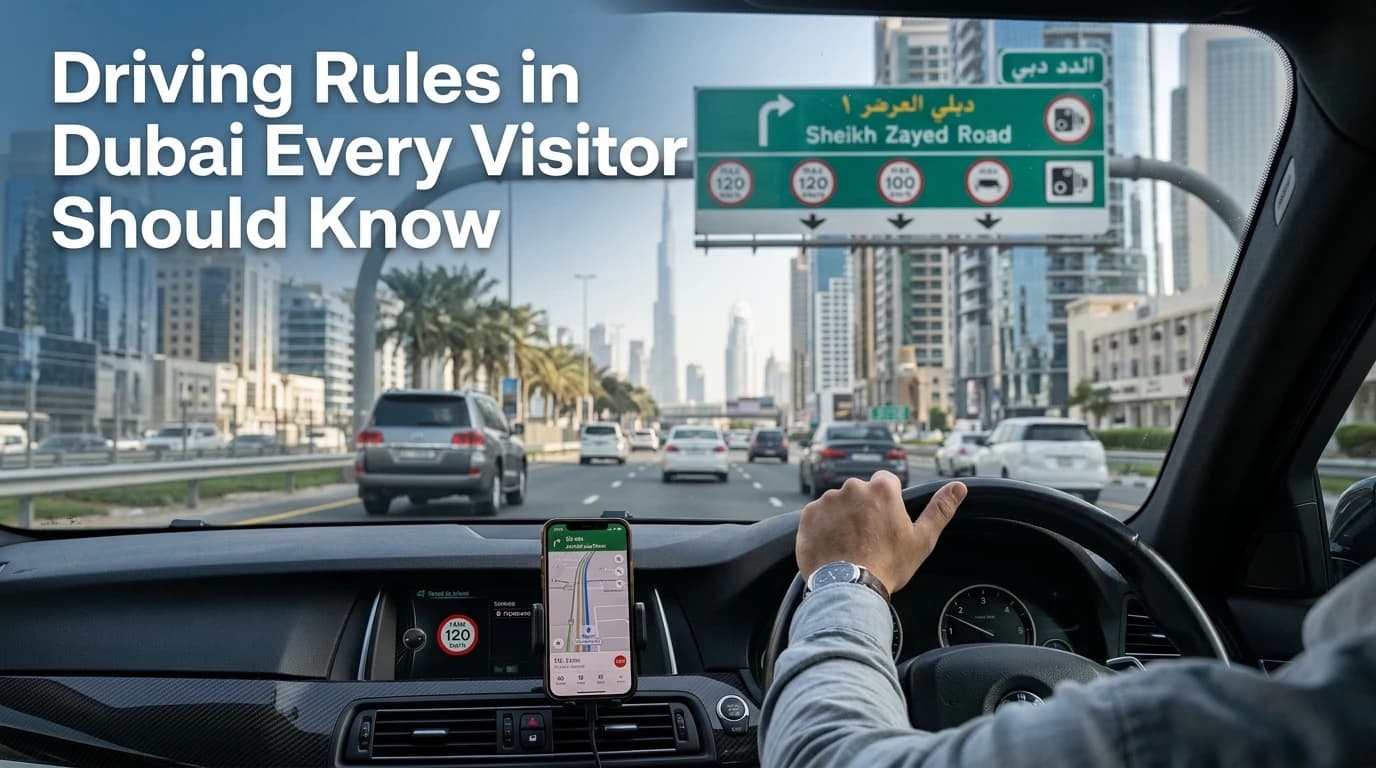
The roads here are wide, the cars are fast, and the rules are stricter than most visitors expect. If you can drive in your home country you can drive in Dubai, but a handful of local rules trip up tourists every week, and the penalties are not small. This is the short list of what genuinely matters on your first few days behind the wheel, not the whole traffic code. Get these right and the rest looks after itself.
First, the basics that change your seating position. Cars in the UAE drive on the right, the steering wheel is on the left, and you overtake on the left. If you come from the UK, India, or anywhere left-hand drive feels normal, give yourself a quiet hour to adjust before you tackle Sheikh Zayed Road at speed.
Zero alcohol means zero
This is the one rule no visitor should get wrong. The UAE runs a 0.00 blood-alcohol policy. There is no "one beer is fine" allowance, and a breathalyser reading of any amount counts as drink driving.
The penalty is built to deter. Under the federal traffic law it runs to a fine of AED 20,000 to 100,000, up to six months in jail, and 23 black points, which is enough to lose your right to drive on its own. For a visitor it can also mean vehicle confiscation and deportation. Your travel insurance will not touch a claim if you were drinking either.
The fix is simple. If you have had anything to drink, leave the car and take a taxi, Careem, or a hotel driver. It is the cheapest decision you will make all trip.
Seatbelts and phones get caught by cameras
Dubai's newer radars are not just watching your speed. AI cameras now flag mobile phone use and unbuckled seatbelts automatically, then send the fine to the car's plate by SMS. No officer pulls you over. The first you hear of it is the rental company billing you days later.
Two rules to bank:
- Everyone wears a seatbelt, front and back. A loose belt anywhere in the car is AED 400 and 4 black points.
- No phone in your hand while driving. Holding it to call, text, or check the map is AED 800 and 4 black points. Mount it on the windscreen and set the route before you move.
Children matter here too. Kids under four need a proper car seat, and a child under ten cannot ride in the front. If you are travelling with little ones, ask for the seats when you book so they are fitted before pickup.
How people drive in the fast lane
The thing that surprises visitors most is not a rule but a habit, and it has its own fine. The far left lane on the highway is for overtaking only. Sit in it at a steady pace and a much faster car will close right up behind you, headlights flashing, expecting you to move over. Do not take it personally and do not brake at them. Just signal, move right, and let them pass.
Tailgating itself is now a serious offence. Following too close carries a AED 1,000 fine and 6 black points, and the AI radars catch it. Keep a clear two-second gap to the car ahead and you stay on the right side of it whether you are the one being chased or the one tempted to chase.
Speed is enforced hard but not identically across the country. Dubai radars generally allow an informal buffer of around 20 km/h over the posted limit before they flash, so a 100 zone tends to trigger near 121. Treat that as luck, not law, because some cameras catch much less and the buffer is never guaranteed. Cross into Abu Dhabi and it vanishes entirely: their cameras flash at 1 km/h over the sign. Go more than 40 km/h above the limit and you are looking at around AED 1,000, 6 black points, and the car possibly impounded. Watch the signs, since limits jump from 60 in town to 120 on the open motorway.
School buses and the hard shoulder
One rule that genuinely shocks visitors. When a school bus stops and extends its red stop sign, every car must stop too, on both sides of the road, until the sign folds back in. Driving past it is AED 1,000 and 10 black points, one of the steepest point penalties on the list. If you see a yellow bus slowing with its lights going, ease off early.
The hard shoulder is for emergencies and nothing else. Using it to undertake, to skip a queue, or to park while you check your phone is treated as a real violation. If you break down, pull onto it, switch on your hazards, get everyone out and behind the barrier, and call your rental company or the police on 999.
Salik tolls, and why your bill arrives later
Dubai has no toll booths. The toll gates, called Salik, read a tag stuck to the windscreen as you drive under them, and your rental car already has one fitted. You never stop and you never pay cash at the gate.
What changed in 2026 is the pricing. Salik now varies by time of day. A gate costs AED 6 during weekday peak hours, roughly 6am to 10am and 4pm to 8pm, and AED 4 off-peak, with passage free between 1am and 6am. Sundays and public holidays sit at a flat AED 4. You will cross several gates on a normal day across the city, especially on Sheikh Zayed Road, so the charges add up quietly.
Here is the part visitors miss. The rental company pays Salik first, then bills you afterwards, sometimes with a small admin fee per crossing. Ask at pickup how your provider handles it so there are no surprises when the final charge lands on your card. For a smooth airport pickup and a car that already has the Salik tag and insurance sorted, you can rent one from us at 24baba and skip the paperwork on arrival.
FAQ — Common Questions Answered.
What licence do I need to drive a rental car in Dubai as a tourist?
You need your valid home country licence plus an International Driving Permit from your own country in most cases. GCC nationals can drive on their national licence. Some nationalities can rent on a home licence alone, so confirm with your rental provider before you arrive, since the eligible list changes. Bring the physical IDP, not just a photo.
How do I pay a traffic fine I got in a rental car?
You usually do not pay it directly. Fines register to the car's plate, so the rental company is notified, settles it, and then charges your card, often adding an admin fee. Keep the deposit hold in mind, because several fines can eat into it before you fly home. If you want to check, the Dubai Police website and app let you search fines by plate.
Is there really no alcohol allowance at all for driving?
None. The limit is 0.00, so even a single drink the night before could still register depending on timing. The penalties run to tens of thousands of dirhams, jail, and deportation for visitors. Never drive after drinking anything, and use a taxi or Careem instead.
Can I drive my Dubai rental to Abu Dhabi or Oman?
Abu Dhabi is fine and a popular day trip, but remember its speed cameras have zero buffer, so stick exactly to the limit. For Oman, including the Musandam peninsula, you need a separate Oman insurance extension and written permission from your rental company. Arrange both before you leave, because crossing the border without them is not allowed.